


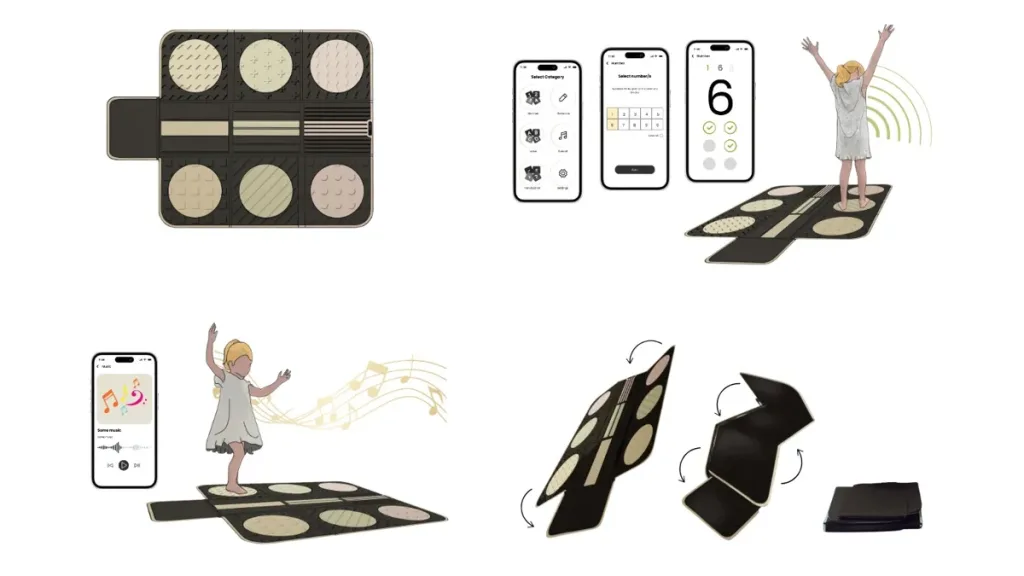
BrailleSteps, an interactive Braille learning mat developed by Sema Betül Akkurt, Zhala Imamova, Rümeysa Aygündüz, and Beste Toprak from Türkiye — and a finalist in the 2025 James Dyson Award — is transforming how visually impaired children experience education. Over 2.2 billion people worldwide live with some form of vision impairment, yet access to inclusive educational tools remains limited (World Health Organization, 2019). For many children, this lack of accessibility affects not only literacy but also independence and confidence.
This breakthrough innovation turns traditional Braille learning into a fun, active, and multisensory experience. Through movement-based interaction, BrailleSteps helps children build confidence, strengthen their tactile recognition, and explore the world fearlessly — combining play and education into one inclusive learning environment.
What Is BrailleSteps and How It Works
BrailleSteps is more than a learning tool — it’s an educational experience. Each of the 12 circular zones on its mat corresponds to a Braille dot, arranged into six Braille cells. Beneath each circle are force-sensitive resistors (FSRs) that detect foot pressure.
When a child steps on the correct combination, the system — powered by a low-energy ESP32 microcontroller — sends real-time signals to a connected mobile app via Bluetooth. The app then provides auditory feedback: a piano note followed by a voice announcing the Braille letter.
This fusion of touch, sound, and movement engages multiple senses at once, reinforcing memory and confidence while allowing children to learn Braille through play.
Inspiration Behind BrailleSteps
The creators of BrailleSteps observed that many visually impaired children feel hesitant to move freely, often due to fear of collisions or unfamiliar environments. At the same time, Braille education is traditionally slow and sedentary — usually involving sitting at a desk and tracing dots with fingers.
Recognizing that children learn best when they move, the team envisioned a tool that merges kinesthetic learning with tactile exploration. By learning Braille through their feet, children not only develop literacy skills but also gain confidence in mobility and spatial awareness, reducing fear and promoting independence (American Foundation for the Blind, n.d.).
The Design and Development Journey
The BrailleSteps team followed a meticulous design process supported by the Middle East Technical University’s Undergraduate Research Fund.
- Phase 1: The first prototype, made from styrofoam, tested spacing, balance, and tactile feedback.
- Phase 2: The layout was widened and enhanced with a walking path and foldable design, improving comfort and accessibility.
- Phase 3: The final prototype featured a textured, tear-resistant surface, integrated sensors, and Bluetooth communication.
Tests with visually impaired children showed high engagement, accurate letter recognition, and improved movement confidence. The design has been registered by METU, and the project was recognized as a semifinalist in Teknofest Türkiye 2025 — one of the country’s premier innovation competitions.
Why BrailleSteps Stands Out
Unlike traditional Braille books or embossed flashcards, BrailleSteps merges education with motion, creating a multisensory learning ecosystem.
| Feature | Traditional Braille Learning | BrailleSteps Innovation |
|---|---|---|
| Learning Mode | Stationary, desk-based | Active, movement-based |
| Feedback | Manual correction by teacher | Real-time audio response |
| Engagement | Limited sensory input | Tactile + auditory + kinesthetic |
| Portability | Books and bulky boards | Foldable, lightweight mat |
| Monitoring | Instructor-dependent | App-based progress tracking |
Through the connected mobile app, teachers and parents can track progress, adjust difficulty, and choose between learning modes — letters, words, or numbers — ensuring every child learns at their own pace.
Impact and Future Development
BrailleSteps promotes inclusive education by bridging the gap between technology and tactile learning. Its wireless and portable design makes it ideal for schools, therapy centers, and homes.
The team plans to:
- Conduct real-user testing to refine usability and interaction.
- Expand learning content to include numbers, short sentences, and themed exercises.
- Localize BrailleSteps for different languages and cultural contexts.
- Scale production for global accessibility and affordability.
Ultimately, the goal is to make BrailleSteps an integral part of inclusive classrooms worldwide, helping children with visual impairments learn with joy and independence.
Call to Action
Innovations like BrailleSteps remind us that accessibility should never be an afterthought. If you’re an educator, designer, or policymaker, support inclusive technologies that empower every child to learn through play.
To learn more about BrailleSteps or explore its impact, visit the James Dyson Award website or METU’s research page for ongoing updates.
References
- American Foundation for the Blind. (n.d.). Braille: Blindness and low vision resources. Retrieved from https://www.afb.org/blindness-and-low-vision/braille
- James Dyson Award. (2025). BrailleSteps – An interactive Braille learning mat for visually impaired children. Retrieved from https://www.jamesdysonaward.org/en-US/2025/project/braillesteps-1
- Middle East Technical University. (n.d.). Undergraduate research (AdımODTÜ) – Research and funding opportunities. Retrieved from https://fle.metu.edu.tr/en/undergraduate-research
- Teknofest Türkiye. (2025). Teknofest finalist projects – Innovation and technology competition. Retrieved from https://www.teknofest.org/en/
- World Health Organization. (2019). World report on vision. Retrieved from https://www.who.int/publications-detail-redirect/world-report-on-vision
Photo and project details courtesy of the James Dyson Award (2025) official project page.