


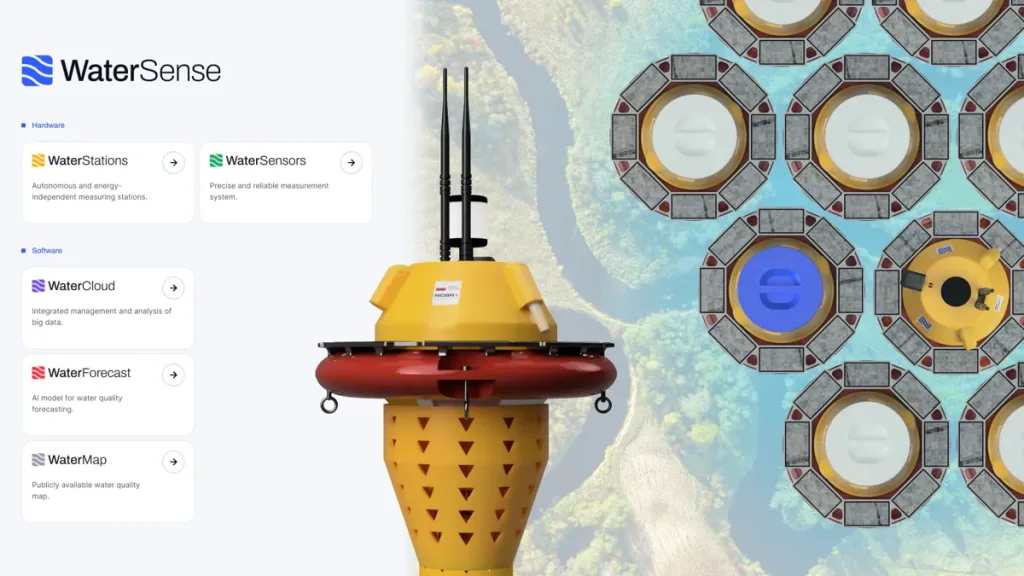
WaterSense: The AI-Powered Innovation Revolutionizing Water Quality Monitoring
Over 63% of Europe’s rivers and lakes are now classified as critically polluted (European Environment Agency, 2025). The consequences are alarming — from declining aquatic biodiversity to contaminated drinking water sources. Traditional water monitoring, which relies heavily on manual sampling, fails to provide a complete and timely picture of water quality.
Enter WaterSense, an AI-powered water quality monitoring system developed by Filip Budny of Poland, and one of the finalists in the 2025 James Dyson Award. This groundbreaking invention combines smart sensors, autonomous technology, and artificial intelligence to track water health in real time. Its mission is simple yet powerful: to make clean, safe water accessible and transparent for everyone.
The Inspiration Behind WaterSense
In the summer of 2022, the Oder River in Poland faced an ecological disaster when a toxic algal bloom led to the death of over 360 tons of fish. Investigations revealed that manual monitoring gaps delayed detection, allowing pollutants to spread unchecked.
This tragedy inspired Filip Budny and his team to create WaterSense, a system that continuously analyzes water without human intervention. Their goal was simple yet revolutionary — to eliminate the randomness in monitoring and offer continuous, automated, and precise water assessment accessible through an open platform: www.watermap.pl
| Feature | Traditional Monitoring | WaterSense Innovation |
|---|---|---|
| Sampling Frequency | Manual, often monthly | Automated, daily sampling |
| Measurement Range | Limited to few parameters | Monitors 20+ water quality factors |
| Maintenance | Requires human servicing | Fully self-sustaining with hydrogenerator |
| Calibration | Manual calibration needed | Automatic two-point calibration |
| Forecasting Capability | Detects existing pollution | Predicts pollution up to 72 hours ahead |
Furthermore, WaterSense can draw water from three customizable depths, providing a layered analysis that reflects true aquatic ecosystem health. This feature is particularly vital for monitoring thermal stratification, nutrient concentration, and pollution dispersion patterns in lakes and reservoirs.
Why AI-Powered Water Monitoring Matters
According to the European Environment Agency (2025), water pollution affects over 100 million people across Europe annually, primarily through contaminated drinking sources and biodiversity loss. Continuous monitoring and early detection can reduce pollution impact by up to 60%, as noted in recent EU Water Policy studies (European Commission, 2024).
WaterSense bridges the gap between environmental science and public access, transforming complex data into real-time visualizations. It empowers governments, scientists, and ordinary citizens to act promptly — a step forward for data-driven environmental protection.
Future Plans: Scaling Across Europe and Beyond
The team plans to expand the deployment of WaterStation Mini to 50 units in Poland by 2025, followed by an EU-wide rollout in 2026, and entry into the U.S. market by 2027.
Their vision is clear:
“Real-time water quality monitoring accessible to everyone, enabling early threat detection and smarter decisions for people, cities, and nature,” says Filip Budny.
Ultimately, WaterSense isn’t just technology—it’s a commitment to transparency, sustainability, and clean water for all.
Call to Action: Supporting Smarter Water Management
For environmental organizations, local governments, and investors, WaterSense represents a scalable opportunity to modernize water safety efforts.
To learn more or track ongoing pilot projects, visit www.watermap.pl
References
- European Commission. (2024). EU Water Policy and Pollution Management. Retrieved from https://environment.ec.europa.eu/topics/water/water-framework-directive_en
- European Environment Agency. (2025). State of Europe’s Waters: Assessment 2025. Retrieved from https://www.eea.europa.eu/publications/state-of-water-2025
- James Dyson Award. (2025). WaterSense Project by Filip Budny. Retrieved from https://www.jamesdysonaward.org/2025/project/watersense
- WaterMap. (2025). WaterSense: Real-Time Water Monitoring Data Portal. Retrieved from https://www.watermap.pl
Photo and project details courtesy of the James Dyson Award (2025) official project page.